Twitter

Wednesday, October 10, 2012

Road to Nowhere: A Phased Redevlopment Plan with a Little Help from my Friends

 Lately I have been focusing on the Road to Nowhere. There have been parts of the City that readers have told me that nobody other than me sheds light on. The Road to Nowhere is not one of those places. Everybody, including me have pondered its future and have tried to pull it out from despair and into a 21st century successful mixed use Neighborhood. As I have pondered its future I came up with some ideas but then I realized I already read them on other blogs, in fact the blogs belonged to fellow bloggers and think tankers like me Gerald Neilly and Peter Tocco. So, for this post regarding the Nowhere I got a little help from my friends.
Photo From AA Road Guides.com
It's obvious that the Road to Nowhere needs helps and that in its current condition, itself and its West Baltimore Neighbors will only worsen. There has been some improvement lately along here in the form of HOPE VI developments Heritage Crossing and Townes at the Terraces replacing Murphy Homes and Lexington respectively. These new low density Town Home development didn't change the layout of the Road to Nowhere which I believe is where the road to block lies.
Photo AA Road Guides.com
 One reason it's called the Road Nowhere and perhaps the biggest is because it is completely useless. It was meant to act as a spur to connect I-70 to Downtown while I-70 was on its way to meeting I-95 near Caton Avenue. Well construction began on this spur located between Franklin and Mulberry Streets in West Baltimore. However the phase of I-70 that was supposed to extend it from the western edge of Leakin Park to I-95 was halted due to outcry from citizens who were against having a highway run through Leakin Park. This, along with the prospect of extending I-83 through Fells Point and Canton elevated the profile of Barbara Makulski and eventually made her the senior US senator from Maryland. What the Road to Nowhere is now was the beginning and end of that attempt to extend I-70 from Leakin Park.
Although all of the Road to Nowhere is terrible shape, we must focus on specific areas and phase redevelopment. The only real interchange the Road to Nowhere has is with MLK Boulevard. At this interchange, traffic exits from the "freeway" where it rejoins Mulberry St. for a signalized intersection with MLK Boulevard. Those who continue on the "freeway" simply go over a bridge over MLK Boulevard where they rejoin Mulberry St. at the western edge of Downtown. This shows how useless the bridge is going eastbound. Lets see how useful it is or is not going westbound.
Photo From AA Road Guides.com
When approaching the Road to Nowhere westbound you're more or less exiting Downtown and venturing into West Baltimore. While on Franklin St. you will have the option to bare left to go on the Road to Nowhere or to stay on Franklin St. for a signalized intersection with MLK Boulevard. It is assumed that if you remain on Franklin St. your destination is MLK Boulevard but it doesn't have to be. Traffic entering both Franklin St. and the Road to Nowhere uses that signalized intersection as well. Theoretically, if you went straight at the intersection and just stayed on Franklin St. you could avoid the Road to Nowhere for its entire length.
Photo From AA Road Guides.com
 When turning onto Franklin St. from MLK Boulevard (west of the bridges) you have to the option of baring left to enter the "freeway" or stay on Franklin St. This little ramp is where Fremont Avenue would have met the Road to Nowhere but instead stops and starts up again at either end of it. So what I've basically determined in these last two paragraphs is that the MLK Boulevard bridges are completely useless.
So, demolishing the bridges and rerouting traffic onto Franklin St. instead of the Freeway is step one thus closing the entire westbound section of it from MLK Boulevard to Monroe St. The eastbound section of the can remain in operation until redevelopment or the Red Line calls for its closure. It will be shortened however to allow for the demolition of the MLK Boulevard bridge so that all traffic will exit at the ramp and rejoin Mulberry St. before crossing MLK Boulevard. Demolishing these bridges will free up a lot of land in between Heritage Crossing and the Terraces. This will constitute Phase I of redevelopment. Since both the Terraces and Heritage Crossing are both lower density Town Homes, I believe it best to streamline those two developments by making the new Neighborhood low density Town Homes as well. The new development will go from MLK Boulevard to Fremont Avenue, which will be reopened at the freeway where access was cut off during its construction. Hopefully this new Neighborhood renamed "Franklin Mulberry Crossing" will spur new development further down the freeway. I think the demolition of the MLK bridges will symbolize a new era of investment and development in all of West Baltimore.
Phase II of redevelopment should occur east of the bridges at the edge of Downtown. I'm speaking of course about the mammoth Social Security Building. Rumor has it that they will be moving to the State Center just a few blocks northwest and this building could and should be demolished. This coupled with its monster parking garage will free up a huge swath of land stretching from Greene St to the east, Franlkin St. to the north, Saratoga St. to the south, and MLK Boulevard to the west. This will be the perfect opportunity for a high density mixed use Residential, Commercial, and Ground Floor Retail Center that will serve a true western gateway to Downtown. In addition, parking garages will be built in the center of the buildings so they are masked to the naked eye.
Phase III of redevelopment involves the Terraces and their frontage on MLK Boulevard. There 's a very busy Rite Aid located here and I think it should redeveloped to create a row of Neighborhood Retail along MLK from Mulberry St. to Saratoga St. Although it will have MLK frontage Violet White Way will serve as a collector street so as not to disrupt traffic on MLK Boulevard. Just south of Saratoga St Violet White Way will be extended so that the site that Lexington Terrace Elementary once stood could be developed as a mid rise low income Senior Apartment Building. Also Lexington St. will be reopened to traffic with a vehicular intersection with MLK.
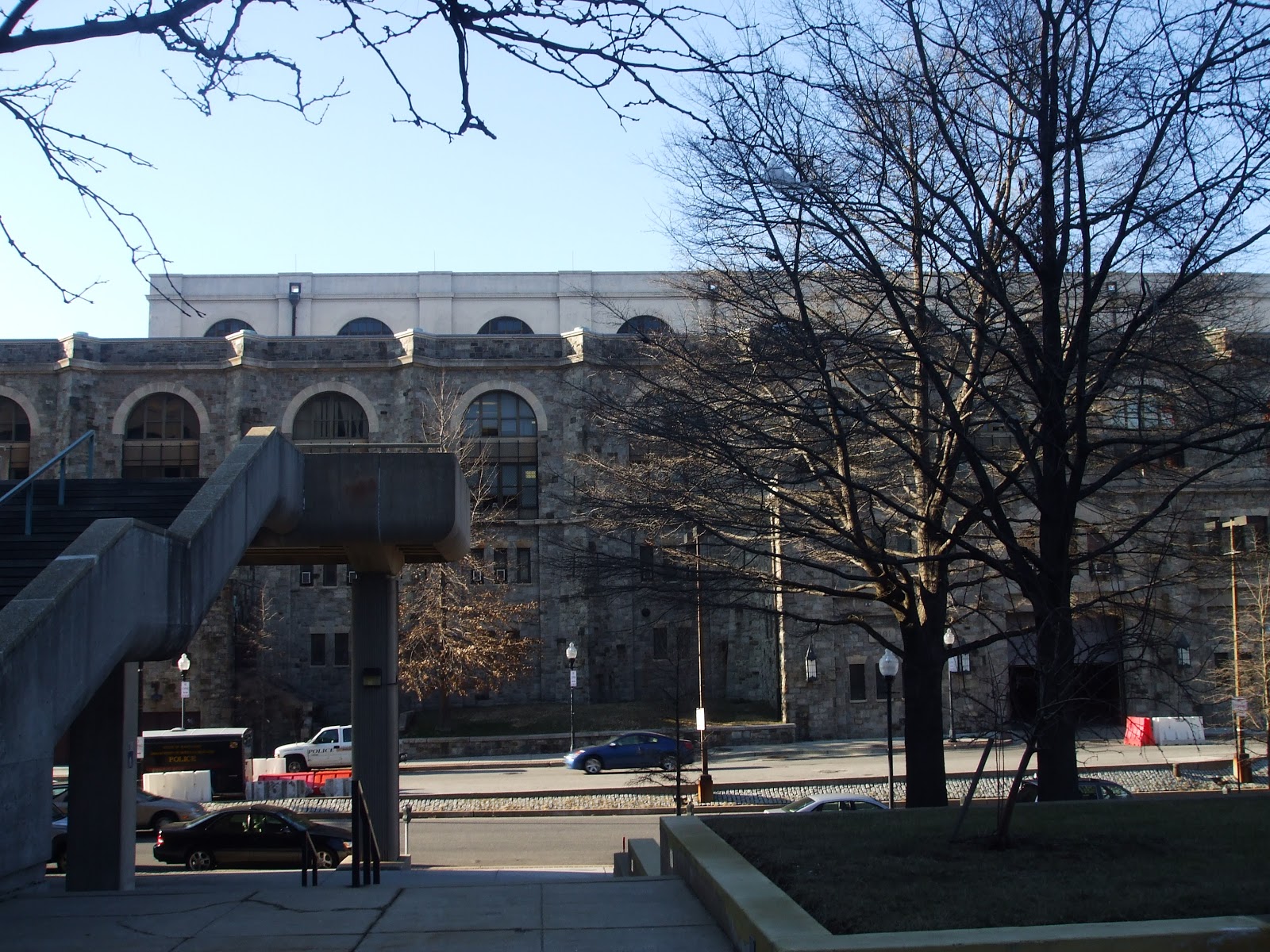
Finally, we come to Phase IV, the final phase in this plan. Phase IV is the southern border of Seton Hill. Seton Hill contains some of the City's best historic housing stock at the best prices while at the same time has lots of mature trees the gem that is Saint Mary's Park. The southern border of the Neighborhood consists of a triangle that is made up of Pennsylvania Avenue, MLK Boulevard and Franklin St. What's there now are suburban style Garden Apartments that appear to be 1970s urban renewal era that were most likely built around the time of the Road to Nowhere. These will be redeveloped as Row Homes that are reminiscent of classic Seton Hill Row Homes that will look like they've been there the whole time. The only difference is that they will have garages in the back to minimize size of the parking pad. These new homes will have frontage on the three mentioned streets and will back to a small "pocket park" that will act as an extension of Saint Mary's Park.  
Photo From AA Road Guides.com
  There will be other phases that go further down the Road to Nowhere but there are already sufficient plans out there that address that area including the West Baltimore MARC redevelopment, the Red Line, and Peter Tocco's Baltimorphisis which shows a rendering of the freeway redeveloped and transformed and how that will positively impact surrounding Neighborhoods. For this post I turned to other blogs and got a little help from my friends.

Tuesday, October 2, 2012

New Housing: Its Effects Won't Spread Enough

Great news! Hope VI Developments and those like them are a much more attractive and safer alternative to their high rise or dilapidated row house predecessor. Not so great news, the success of the development isn't helping the rest of the Neighborhood. The goal of redeveloping these hot beds for crime and urban decay wasn't just to get rid of crime and blight at the site that was redeveloped but have the effects of said redevelopment spread throughout the Community. I'm going to examine some of these new developments and their surroundings to see what is keeping their Neighboring Communities from reaping the benefits of redevelopment without redeveloping the entire City.
The theory that existing development will gentrify when new development is built nearby has its merit. All one has to do is look around the Harbor. As it was redeveloped effects of it spilled over into Fells Point, Federal Hill, Canton, Little Italy, and Patterson Park. These row house Communities located near Downtown in the Harbor were once home to industry and the row homes housed the workers in said industries. When manufacturing and shipping left Baltimore so did Residents of these Neighborhoods in search of new work. When the Harbor became a tourist attraction, Residents began flocking back to these Neighborhoods and gentrification spread like wild fire. So when it came time for HOPE VI developments, Residents and City Planners alike were optimistic that replacing high rises with new town homes would gentrify entire Neighborhoods like the harbor. Lets examine these Neighborhoods and see what we're up against.  
First lets go to West Baltimore where two notorious slums were imploded; Lexington Terrace and Murphy Homes. Today they're Town Home Communities known as Townes at the Terraces and Heritage Crossing Respectively. The Road to Nowhere separates these two Communities. Both new developments are located in otherwise bad areas. Terraces are located in Poppleton while Heritage Crossing borders on Harlem Park and Upton. When their high rise predecessors were built, the crime that came with them spilled over into Neighboring private row house communities. 
When Murphy Homes was demolished, a lot of its crime went with it but the damage had already been done in neighboring Upton and Harlem Park. Now its Heritage Crossing Residents who complain about the spillover of crime and drugs from Upton and Harlem Park.
A similar story can be told in the Terraces. Although it has a much higher percentage of public housing units than Heritage Crossing, it is still much better than its high rise predecessor. Poppleton, where the Terraces are located is receiving a good deal of investment other than just the Terraces (something Heritage Crossings' surrounding aren't receiving) this includes the UMB Biotech Park and several blocks of housing that's being redeveloped by the City. One thing the Biotech Park is hoping to do is provide entry level jobs in the Biotech field for local Residents (ones that don't require high levels of education) and lure new Residents in who will be working in the Biotech Park. Whether these goals will come to fruition is yet to be seen. 
I would make the argument that in order for Poppleton to make a full turn around that Poe Homes must be redeveloped as a mixed income community the way  Lexington Terrace was replaced with the Townes at the Terraces. Sadly concentrated public housing like that found in Poe Homes is a deterrent to new Residents, hence the population loss.
Now we go to East Baltimore and its HOPE VI developments. Here, there has been a more positive synergy for change that has allowed some developments to flourish much better than their western counterparts. What I mean is, developments surrounding the new HOPE VI developments have had a more positive spillover effect. 
The first development was Lafayette Courts which is now Pleasant View Gardens. It was a development of public housing high rises that was demolished and replaced with the town homes that we now know as Pleasant View Gardens. The problem with Pleasant View Gardens is that it doesn't have a great enough mix of incomes so almost all of the Town Homes are public housing. It is however a much safer Neighborhood. It also doesn't have very many Residential developments immediately surrounding it so it's hard to gage its success but I'll give it a try none the less. 
To the north of Pleasant View Gardens was Somerset Homes. In 2009 it was torn down and the land has been banked for future development. If Pleasant View Gardens was meant to have a positive spillover effect on Somerset then it failed miserably . Otherwise Somerset would still be standing.
Also to the north is Old Town Mall. This diamond in the rough probably had a negative spillover effect as a result of Pleasant View Gardens. Remember Lafayette Courts was high density and Pleasant View Gardens has only a fraction of the number of units that its predecessor did. 
To the east is Douglass Homes. I have been calling for the redevelopment of Douglass Homes for quite some time now but the Old Town Mall Redevelopment Plan calls for simply reinvesting in the existing development. It appears I won't be getting my wish any time soon. 
A couple blocks south of Pleasant View Gardens is our next HOPE VI development; Albemarle Square. Albemarle Square was built on the grounds of Flag House Courts, a public housing high rise development that ravaged Historic Jonestown and caused Neighboring Little Italy and Fells Point to wall themselves off from their once beloved neighbor. 
 Little Italy and Fells Point remained relatively stable throughout the life span of Flag House Courts so when it hit the wrecking ball Little Italy and Fells Point welcomed their new town home Neighbors of Ablemarle Sqaure with open arms. Little Italy and Fells Point didn't need the help of Albemarle Square as they were already thriving but the rest of Historic Jonestown sure did. 
Interspersed within Albemarle Square are old row homes some of which are store front Retail that were in dire states during the tenure of Flag House Courts. Now that Albemarle Square has freed Jonestown from the grip Flag House had on it, these old row homes are being carefully restored one by one. This is an instance where a HOPE VI development has had its positive effects spread.
The last HOPE VI development we will discuss is Broadway Overlook. Can you say location location location? It's located just a stone's throw away from Johns Hopkins Hospital, Fells Point, and Patterson Park. Like Albemarle Square it has helped its neighboroing communities of Washington Hill and Butchers Hill to gain population by restoring existing housing stock. Boradway Overlook also boasts some of the best views of Downtown.
Now redevelopment in Baltimore is more than just HOPE VI developments and the Harbor there are plenty of other spots in that have undergone redevelopment most notably the southeastern part of Sandtown. Like the HOPE VI developments in west Baltimore, the success in Sandtown is pretty much contained to the redeveloped areas. 
Also in West Baltimore close to the entire Druid Heights Neighborhood is being torn down and rebuilt. I think it will be like Sandtown in that the part will be very nice but it likely won't have much effect on the neighboring communities of Penn North, Upton, and northern Sandtown.
The final community in question is Uplands. This has been a long contested area that had been blighted and losing population for quite some time. The finished product will be quite suburban in nature but will its massive size calm things down in Edmondson Village? Time will tell.
So what have we learned today? I think we've learned that if you're redeveloping in a desired location the synergy of said development will spread but if you're in a rough part of Town there is no way quick and easy way to make that synergy spread and it will be a long arduous process to create change.
  

Friday, September 28, 2012

Reservoir Hill: Lets See Some Population Growth

I have a great fondness for Reservoir Hill so it gives me great pleasure when new Residents email me and write in the comments field that they have purchased their dream home in Reservoir Hill and have restored it to glorious perfection and that they have best Neighbors one could ask for. On the other hand, Reservoir Hill continues to lose population, is plagued with boarded up buildings, has trash strewn about the streets and alleys, and vacant overgrown lots. It appears that the grassroots efforts to revitalize Reservoir Hill don't make for a net population gain and on some streets are just a drop in the bucket in rehabbing the gems that are Reservoir Hill's housing stock. Fear not, I have some ideas that should pump up the volume on reinvestment in Reservoir Hill and finally give it some net population growth.
First off, in my research of Reservoir Hill I learned that something I thought needed to be done is actually being done; demolishing the crime infested Madison Park North Apartments is a done deal. I was going to suggest that the aging complex nicknamed "Murder Mall" hit the wrecking ball because it creates a barrier between Bolton Hill and Reservoir Hill. The draining out of this complex may be the reason as to why Reservoir Hill as a whole lost population. Given its close location to MICA it has been suggested that the vacant property be developed for use as Student Housing. MICA has not however given any interest in buying and developing the land. It is currently unclear what will go where Madison Park North is. Hopefully the synergy created by Station North on North Avenue across I-83 will make its way to the Bolton Hill Reservoir Hill area.
Next we go to the opposite end of Reservoir Hill to Druid Lake. This should be some of the sought after property in the City but it isn't and I can tell you why in three letters; HUD. Most of the undeveloped land HUD has a 99 year lease on which makes building upscale housing on it a no go (like the ill fated Vistas on the Lake.) They key to bringing in real population growth all around Reservoir Hill is large scale development and there's plenty of land with Druid Hill Park frontage that this can happen. What first has to happen though is HUD must give up its lease on that land which in its current only allows for Section 8 or public housing.
In its heyday, Reservoir Hill was home to lots of luxury Apartment and Condo buildings. Many of these buildings are still standing but are vacant or are otherwise in distressed condition. I think fully restoring these diamonds in the rough and re renting and sell them as the upscale gems they once were would help in bringing back the elegance and stateliness that Reservoir Hill has historically been known for. It appears that a lot of these smaller buildings were once used as group homes more recently but have been vacated and they are now boarded up and empty. Restoring these to their grandiose elegance will continue to attract more population to Reservoir Hill.
Last but not least we come to what dominates the landscape of Reservoir Hill; Row Homes. Row Homes are where the bulk of Reservoir Hill's new population comes from. There are a lot of row homes here that have been carefully and handsomely restored to their former grandeur. On the flip side there are plenty that are boarded up and have been for years. Row Homes in Reservoir Hill are very large and I think that's its hubris. The larger the home, the more expensive it is to restore it. I think that may have a lot to do with the fact that many of the Neighborhoods that have gentrified in Baltimore contain smaller "cookie cutter" row homes IE Fells Point, Canton, Patterson, Park, Federal Hill etc. Other Neighborhoods with larger row homes like Reservoir Hill haven't decayed like Reservoir Hill has IE Bolton Hill, Mount Vernon, and Charles Village. In order to restore some of the homes in Reservoir Hill, it may take a construction budget anywhere from $100k upwards of a quarter million dollars. Keep in mind that's only the construction budget, that doesn't include actually purchasing the home which could be another $100k. 
I have suggested bringing back the $1 row house program many times over and I think Reservoir Hill is the perfect place to do so. Given how expensive it will be to restore its housing stock to its former grandeur, I think it best for new Home Owners to dedicate all of their money towards construction. Remember these are large homes with lots of interior and exterior details so that doesn't come cheap. That being said, in order to buy a Reservoir Hill row home for $1 the buyer must qualify for at least a $100k mortgage loan to ensure that the construction is done. In some of the more dilapidated homes that loan amount might be bumped up to $200k because they would require more work. 
Reservoir Hill has been waiting to come back big for years now and there are new home owners moving in but there are certain things that are keeping a mass population spike such as Madison Park North and an excess of vacant Apartment Homes as well as views that aren't taken full advantage of. Once these problems are eradicated, Reservoir Hill will truly experience population growth.  

Tuesday, August 28, 2012

Redefining Downtown's Westside

For well over a decade, Baltimore has tried to reclaim the Westside of its Downtown as the Retail and Shopping Mecca it was before the flight to the suburbs. There has been some success in attracting Residents here as evidenced in the population growth in the 2010 census but Major Retailers have avoided the Westside of Downtown. That's not to say Retailers have avoided Baltimore all together, quite the contrary it's just been in other part of the City. I will attempt to explain why Baltimore has evolved and what that means for the Westside of Downtown.
The flight to the suburbs and the threat of integration killed Downtown's Westside no doubt about it. Lexington and Howard was the intersection to envy if you were a Baltimore Department Store as this was where their Flagship stores once stood. The original locations of Hutzlers, Hoschild Kohn, Hechts, and Stewarts flanked this proud intersection. Not far was Brager Gautmans, McCrorys, and many many more. As Baltimore began losing population to the suburbs and these Department Stores began opening branches in said suburbs, sales in their Downtown Stores plummeted and they began scaling back services like Personal Shoppers and Same Day Home Delivery. Also these "Grand Dame" locations were made smaller until finally closing all together.
Downtown before the fight to the suburbs had loosely defined boundaries; first there was the Westside which was the Retail and Shopping District, there was the Central Business District which is largely where it is today (Charles Center) and then there was the Harbor. The Harbor served as an Industrial Port for Shipping, Manufacturing of everything from textiles to cans and everything in between. 
In 1980 when Harbor Place opened the Inner Harbor was officially redefined. The once Industrial Port became a Retail and Recreationally oriented zone that began attracting the very Retailers that the Westside had lost and was trying to lure back. With the rebirth of the Inner Harbor Downtown began to expand itself including Neighborhoods Federal Hill, Fells Point, and Canton. These same Retailers began flocking to these Neighborhoods instead of the Westside. The opening of Inner Harbor and the future opening of Harbor Point will bring high end Retailers to these Neighborhoods as well. 
Now where does this leave the Westside? After all, its identity as a Baltimore's Retail and Shopping Destination has been taken from it by the Inner Harbor and its Neighborhoods. It's not like the Westside can swap identities with what the Harbor used to be; an Industrial Port because we have entered a service oriented economy instead of a manufacturing one. That still didn't answer the question of how to redefine the Westside. City Planners haven't gotten it through their heads that the Westside can't once again be a Shopping District and that the boundaries of Downtown have been altered. 
Despite not making much progress in the Retail department and there being trash on the streets as well as unmaintained roads and  sidewalks, the westside of Downtown has gained population. This gain in population can be attributed to Historic Retail Buildings being converted into Apartments and Condos like the old Hechts and Stewarts Buildings. 
I foresee the Westside of Downtown being converted into more of a Midtown District College Town like Bolton Hill, Mount Vernon, and Charles Village with convenience Retail, restaurants and pubs such as reopening the White Coffee Pot (pictured above). This should be relatively easy because there are lots of Colleges and Universities just a stone's throw away from Downtown's Westside. A big player to indicate activity in the Westside will be returning the entire Hutzler's Building to productive use. There are also Row House style Retail buildings that are vacant and would make great Residential conversions. Since they're quite narrow it might not be a bad idea to convert two into one to make them wide like those in the aforementioned communities.
 Although successful Residential conversions are what have made the Westside of Downtown gain population its most important show case will not be such. The main attraction to the Westside will continue to be Lexington Market. Lexington Market should be expanded to include healthier vendors and more upscale foods as well.
There's a project that's been shelved next to Lexington Market that I think should be brought back to light; The Residences at Lexington Market. This mixed income housing development will consist of two high rise Apartment Buildings, a Condo Building, and 23 Town Homes built atop the parking garage pictured above.
In addition to being a world class Public Market and new upscale Residences, Lexington Market must also be the area's number one Transit Center. I've said it before and I'll say it again; the Red Line must go through Downtown and not around it and Lexington Market is a crucial stop for it because both existing lines meet there and to make the area a transit hub, multiple lines be it rail or bus will have to stop there. I think that the Red Line has the potential of making Lexington Market a true gem.
In Downtown's Westside, despite the population gain, there appear to be signs of disinvestment. The roads are in terrible shape as are the sidewalks and lighting could be better. Charles St. in Mount Vernon just completed a very attractive streetscape project that I think will complement the Westside of Downtown very well. The project included newly paved roads, new sidewalks, cross walks, additional street lights, and new traffic lights (pictured below.) 
Now that Downtown's Retail and Shopping District has moved to Inner Harbor East and Harbor Point, we must now redefine the Westside of Downtown in order to breathe more new life into it.